Plant Hardiness ARS USDA: Read the Official Zone Map
Learn what plant hardiness ARS USDA means, how the official zone map works, and how to use your USDA zone before buying perennials.
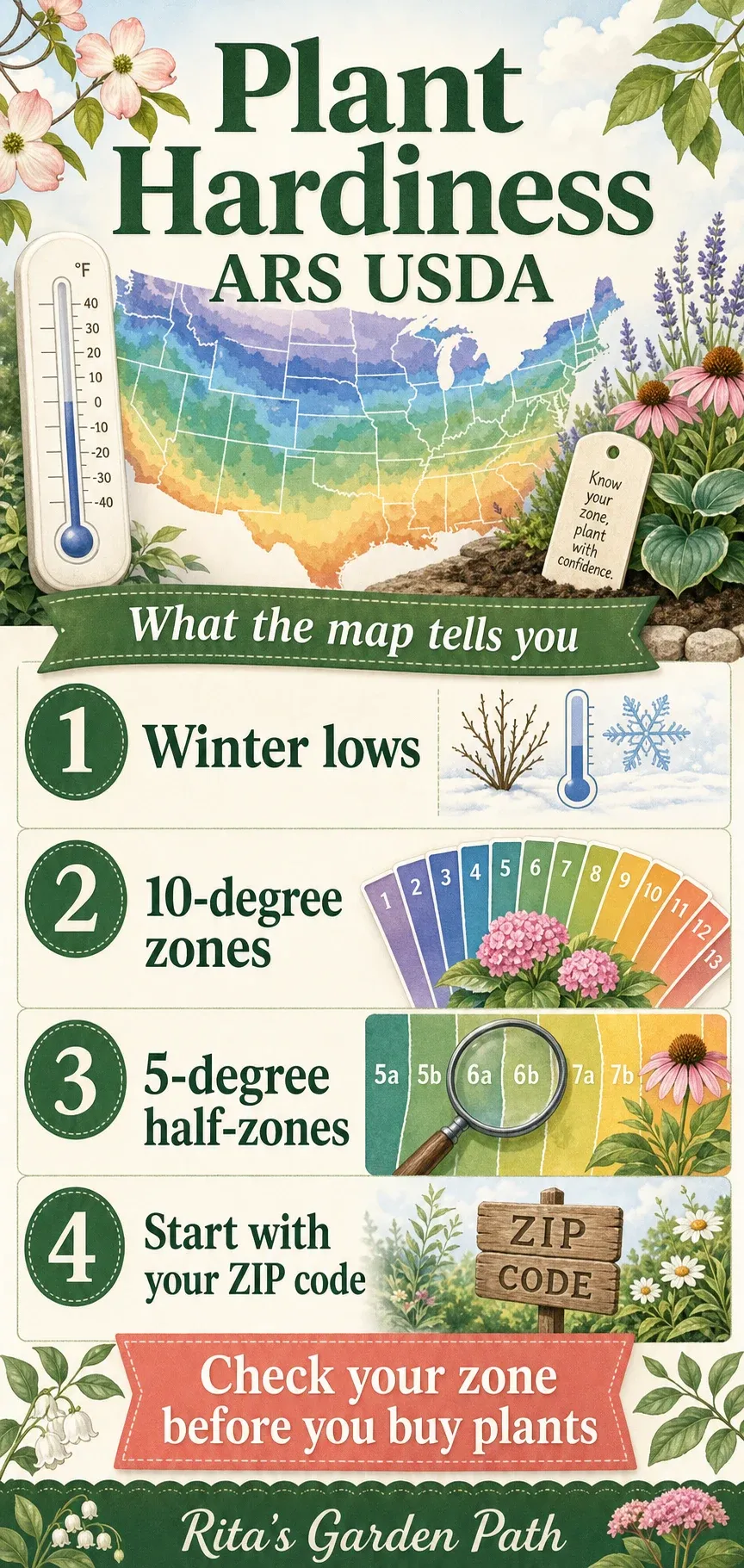
If you searched for plant hardiness ARS USDA, you are probably trying to answer one practical question: “Will this plant survive winter where I live?”
The official answer starts with the USDA Plant Hardiness Zone Map, maintained by the U.S. Department of Agriculture’s Agricultural Research Service, usually shortened to USDA-ARS. For gardeners, that map is not just a colorful chart. It is the baseline tool for matching perennial plants, shrubs, vines, and trees to the coldest winter temperatures they are likely to face.
Before you buy another plant tag that says “hardy to Zone 6,” use Rita’s interactive USDA hardiness zone map to find your zone. Then come back to this guide so you know what that number actually means.
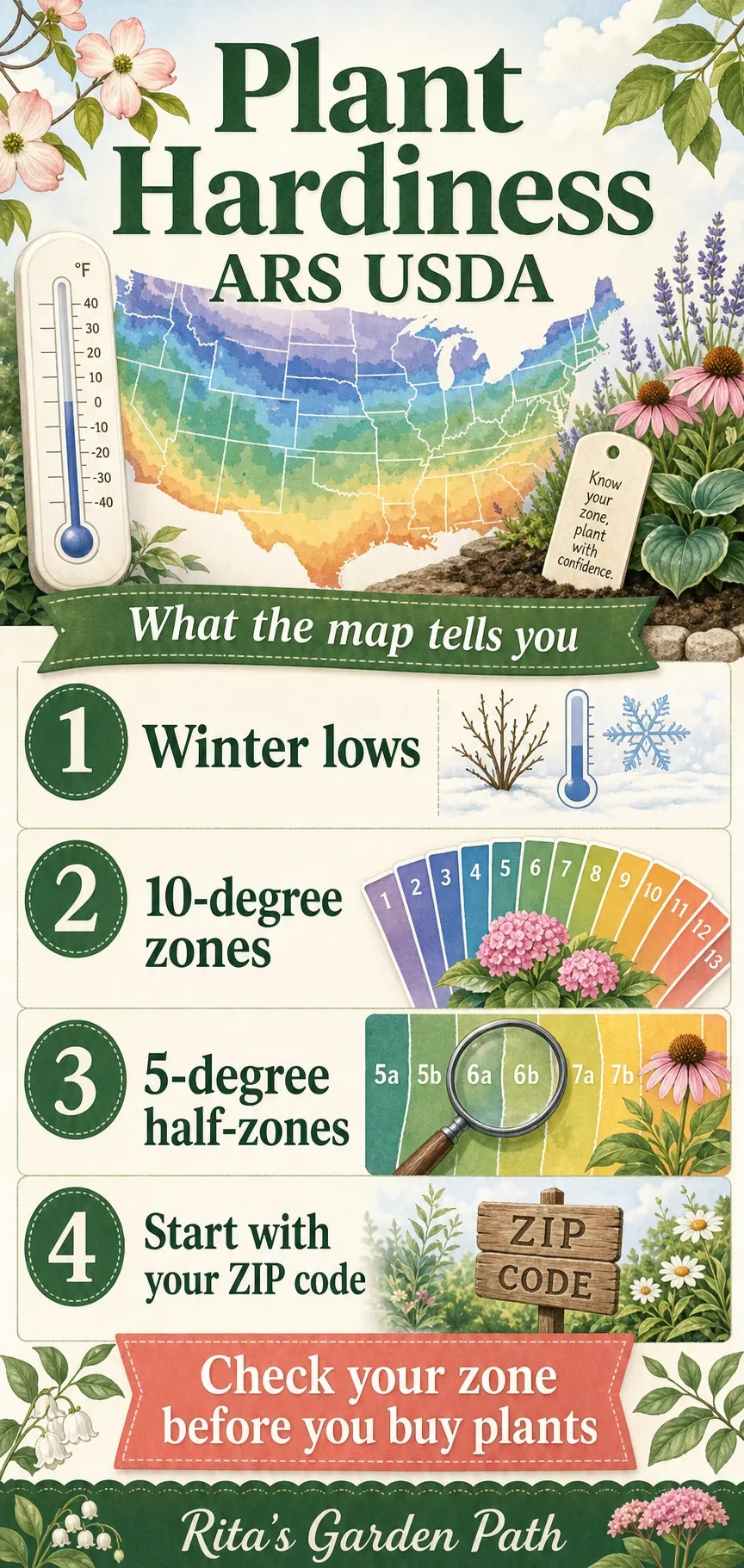
What “Plant Hardiness ARS USDA” Means
The phrase plant hardiness ARS USDA points to three connected ideas:
- Plant hardiness means a plant’s ability to survive cold winter conditions.
- ARS stands for Agricultural Research Service, the USDA research agency behind the official map.
- USDA stands for the United States Department of Agriculture.
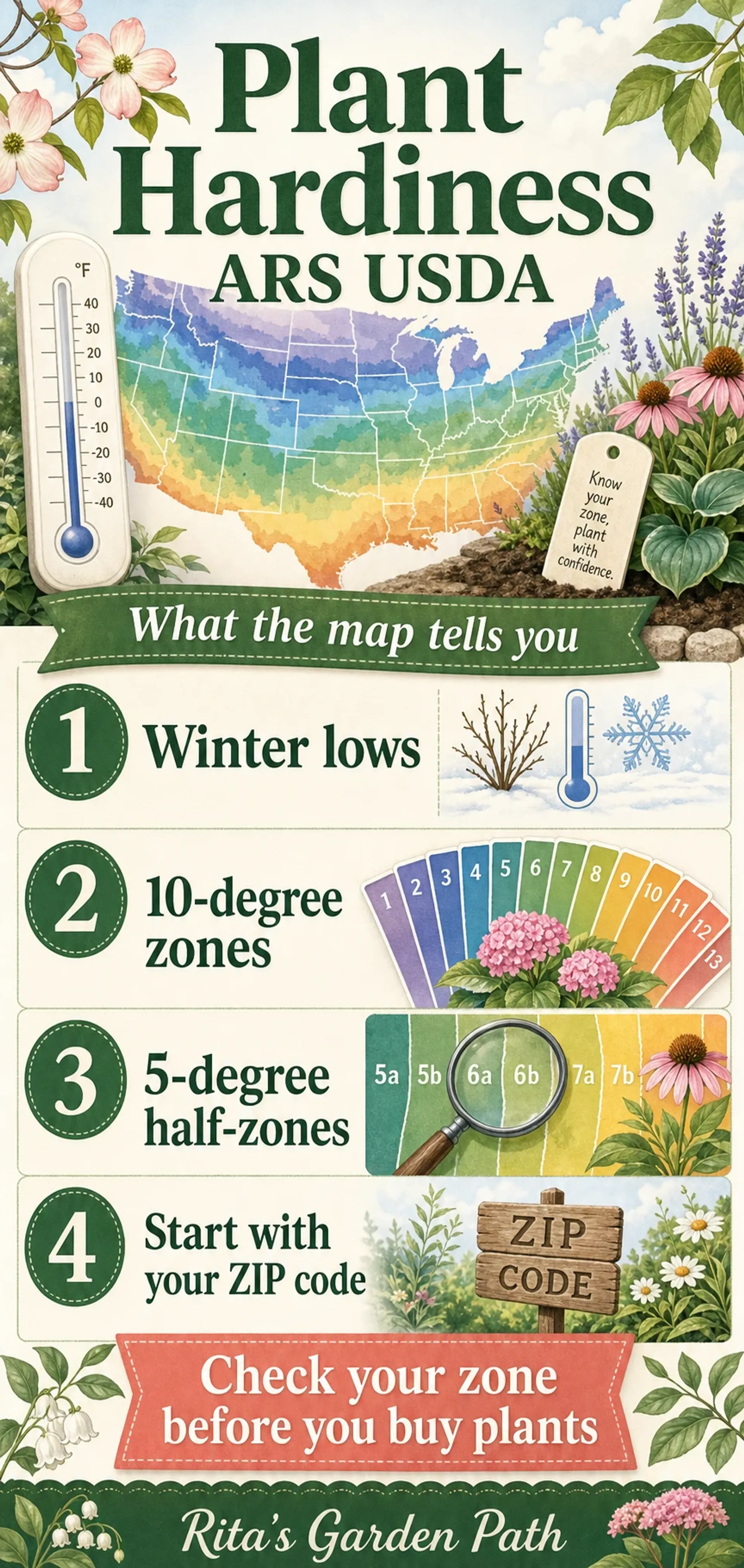
Together, they refer to the official USDA-ARS Plant Hardiness Zone Map and the science behind it. The map divides the United States and Puerto Rico into zones based on average annual extreme minimum winter temperature. In plain English, it estimates how cold your area usually gets at its coldest point in winter.
That matters because many garden plants are sold with zone ranges. A perennial marked “Zones 4-8” is expected to survive winter cold in those zones, assuming the rest of the site fits the plant’s needs.
The Map Measures Winter Lows, Not Everything About Your Garden
The USDA-ARS map is based on the average annual extreme minimum winter temperature. It does not measure the hottest summer day, rainfall, soil drainage, humidity, wind exposure, deer pressure, or your exact first and last frost dates.
This is where gardeners sometimes get tripped up. A plant can be hardy in your zone and still fail because it was planted in the wrong light, soggy soil, dry winter wind, or a spot that gets too hot in summer.
Think of your hardiness zone as the first filter, not the final decision.
Use it this way:
- Find your USDA zone.
- Choose plants rated for that zone.
- Check sun, water, soil, mature size, and maintenance needs.
- Adjust for your yard’s microclimates.
Once you know your number, you can explore plants by USDA hardiness zone or search the plant library by common or scientific name.
How USDA Hardiness Zones Work
The current USDA Plant Hardiness Zone Map uses 10-degree Fahrenheit zones. Zone 1 is the coldest, and Zone 13 is the warmest. Each full zone is also split into two 5-degree half-zones: “a” for the colder half and “b” for the warmer half.
For example:
- Zone 6a is colder than Zone 6b.
- Zone 7b is warmer than Zone 7a.
- A Zone 5 garden generally faces colder winter lows than a Zone 8 garden.
That half-zone can matter when you are choosing borderline plants. If a plant is rated for Zone 7 and you garden in Zone 6b, it might survive in a sheltered spot during mild winters. But if your yard is exposed, windy, or prone to cold air pooling, it is a riskier choice.
What Changed in the 2023 USDA-ARS Map
The 2023 USDA Plant Hardiness Zone Map uses weather data from 1991 to 2020. USDA-ARS explains that this 30-year period helps smooth out year-to-year weather swings while still reflecting a more current climate record than older maps.
The 2023 map is also digital and GIS-based, which means it can show finer local detail than older printed maps. USDA-ARS notes that the map is built from a digital grid, with each cell measuring about a half mile on a side. That improved detail helps account for local factors like elevation and proximity to large bodies of water.
Still, even a detailed map cannot know every backyard.
USDA-ARS is clear about this: a hardiness zone is a general guide, not a guarantee. Your own garden can have warmer or colder pockets because of pavement, walls, slopes, shade, wind, or low spots where cold air settles.
Use Your ZIP Code, Then Use Your Eyes
The official USDA map lets you search by ZIP code. Rita’s USDA hardiness zone map makes the same kind of task easier for garden planning: find your zone, then move into plant discovery.
But once you know your zone, walk your yard.
Look for:
- South-facing walls that hold heat.
- Low areas where cold air settles.
- Windy corners that dry out evergreen leaves.
- Raised beds that drain faster than in-ground beds.
- Shaded areas where soil warms slowly in spring.
- Concrete, brick, or gravel that can create warmer pockets.
These microclimates can explain why one plant thrives on one side of a house but struggles on the other. No map can replace what you learn by watching your own garden through a few seasons.
What the USDA Zone Map Can and Cannot Tell You
Here is the clearest way to use the plant hardiness ARS USDA information.
The map can tell you:
- Your average annual extreme minimum winter temperature range.
- Whether a perennial is likely to survive winter cold in your area.
- How your zone compares with nearby areas.
- Whether a plant tag’s hardiness range is a good starting match.
The map cannot tell you:
- The exact best day to plant tomatoes.
- Whether your soil drains well.
- Whether a plant will bloom heavily in your yard.
- How much summer heat your garden gets.
- Whether a plant will handle deer, rabbits, drought, or clay soil.
That is why a smart plant choice combines hardiness zone data with real plant traits.
For example, if you garden in Zone 5, you still need to know whether a plant wants full sun, part shade, dry soil, wet soil, low maintenance, or protection from winter wind. If you garden in Zone 9, you may be more worried about heat, humidity, water needs, and summer stress than winter survival.
A Simple Plant-Buying Checklist
Use this checklist before you bring home a perennial, shrub, tree, or vine:
- Find your USDA zone. Start with the interactive zone map.
- Read the plant tag. Look for a hardiness range such as Zones 4-8.
- Stay inside the range. If your zone is colder than the plant’s range, treat it as an experiment.
- Match the light. Full sun plants usually need at least six hours of direct sun.
- Check water needs. A dry-site plant may rot in wet soil, even if it is zone hardy.
- Look at mature size. A cute one-gallon shrub can become a problem if it wants 10 feet of space.
- Consider your microclimate. Protected courtyards, exposed slopes, and low frost pockets behave differently.
If you want a shortcut, search the plant library after checking your zone. You can compare plant type, sun exposure, bloom time, water needs, maintenance level, and tolerances before you buy.
Common Mistakes Gardeners Make With Hardiness Zones
Mistake 1: Treating the Zone as a Promise
A zone rating is not a guarantee. It is a good starting point based on average winter lows. A rare cold snap can still damage plants, especially those planted at the cold edge of their range.
Mistake 2: Ignoring Water and Soil
Many “hardy” plants fail because their roots sit in wet winter soil. Cold plus soggy soil is a hard combination for plants that need drainage.
Mistake 3: Forgetting Evergreens Lose Water in Winter
Broadleaf evergreens and conifers can suffer in dry winter wind. A plant may be cold hardy but still get winter burn if it is exposed, dry, or stressed.
Mistake 4: Buying One Zone Too Warm
If you live in Zone 5, a plant rated Zones 6-9 is not impossible, but it is not a dependable choice. Save those experiments for protected spots, containers, or plants you are willing to replace.
Best Next Step: Find Your Zone, Then Pick Plants That Fit
The plant hardiness ARS USDA map gives gardeners a shared language for winter survival. It helps nurseries label plants, researchers compare regions, and home gardeners avoid expensive mistakes.
But the best results come when you use the map with common sense. Start with your zone. Then match the plant to your light, soil, water, space, and maintenance style.
Ready to plan with less guessing? Check your USDA hardiness zone, then browse plants by zone to find options that fit your climate.