Rapeseed (Brassica napus (Oleifera Group))
Rapeseed (Brassica napus (Oleifera Group)) is a low-maintenance annual known for bright yellow blooms, providing significant global oil yield.
Scroll down to discover growing tips, care requirements, companion plants, and more
Complete Plant Information
Overview
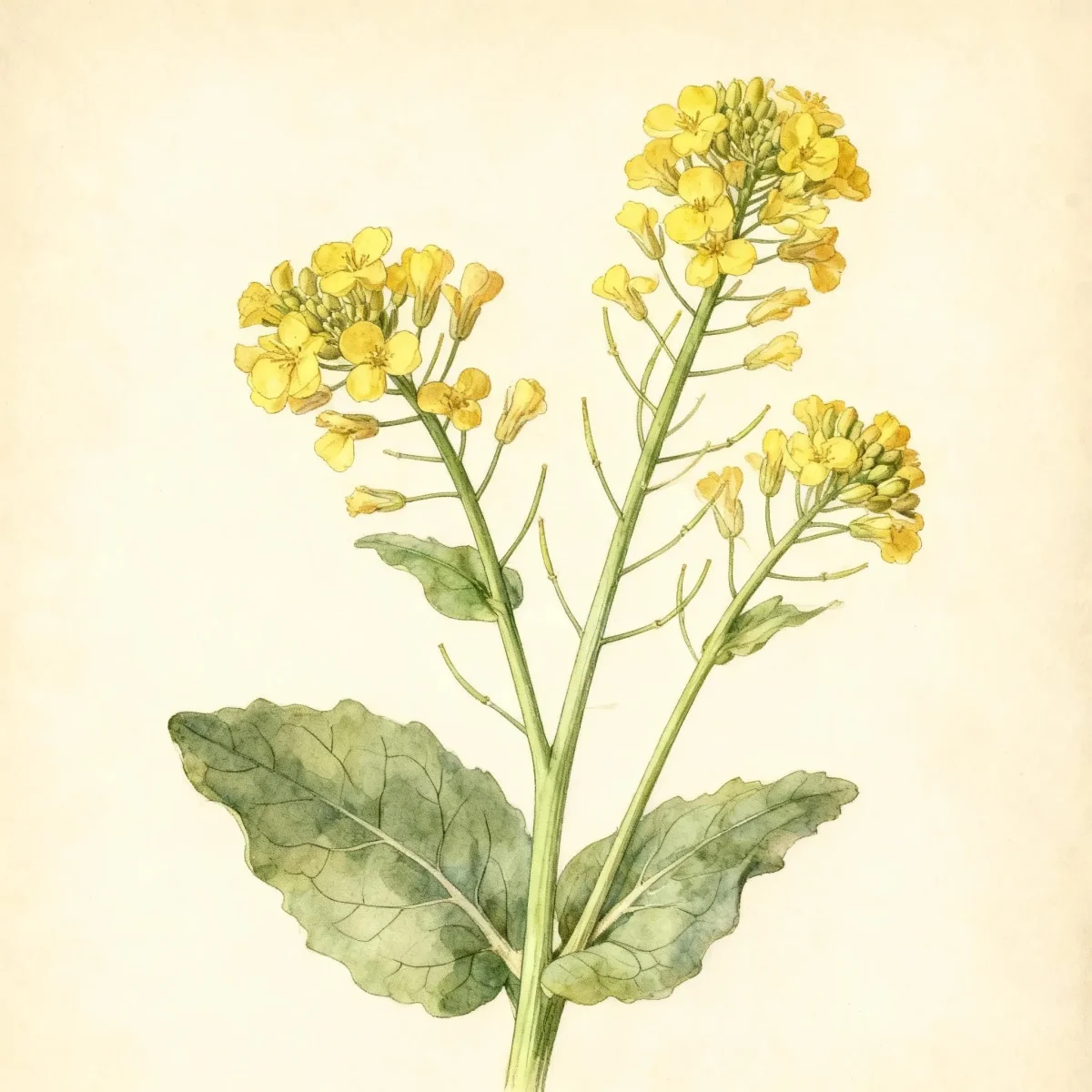
The Rapeseed plant, scientifically known as Brassica napus (Oleifera Group), is distinguished primarily for its agricultural importance, being a massive global source of vegetable oil. While often seen in large commercial fields, its striking display of four-petaled yellow flowers from May through September offers notable aesthetic value. This annual thrives with relatively simple requirements, making it an unusually robust species within the Brassicaceae family.
As a species commercially cultivated for oilseed production, Rapeseed often escapes cultivation and can naturalize in wild areas, demonstrating good adaptability across a broad range of climates. Its growth habit results in a plant reaching 2 to 4 feet tall, crowned by vibrant yellow blooms that contrast nicely with its large, flattened leaves.
Although Brassica napus (Oleifera Group) is typically a commercial entity rather than a dedicated home garden perennial, understanding its needs—especially regarding soil richness and consistent moisture—is key to observing its energetic springtime growth.
Fast Facts
- Plant Family: Brassicaceae
- Plant Type: Annual
- Hardiness Zones: USDA Zones 2-11
- Size at Maturity:
- Height: 2-4 ft
- Spread: 1-2 ft
- Bloom Time: May to September
- Bloom Description: Yellow
- Sun Exposure: Full sun
- Water Needs: Medium
- Maintenance Level: Low
How to Grow
For optimal performance of Brassica napus (Oleifera Group), choose a site that provides full sun exposure, although it can tolerate light afternoon shade. The best results are achieved in organically rich, consistently moist, well-drained loam soils. Crucially, aim for a soil pH level maintained between 6.0 and 7.0 for healthy nutrient uptake.
Watering requirements are medium; ensure the soil remains consistently moist, especially during active vegetative growth and flowering periods. Since Rapeseed is often utilized as a commercial energy crop, excessive fertilization is usually guided by agronomic needs; however, rich soil preparation minimizes the need for heavy mid-season feeding in garden settings.
Cultivation practices differ based on variety. Annual forms are best suited for regions experiencing cold winters, necessitating spring planting after the danger of hard frost has passed. Conversely, biennial types perform better where winters are significantly milder, allowing them to establish more fully before the main bloom.
Landscape Uses
While Rapeseed is not commonly sited in conventional home perennial borders, its use as an annual or its tendency to naturalize offers unique landscape opportunities. In large open spaces or meadows where its vibrant yellow hue is desired, allowing Brassica napus (Oleifera Group) to naturalize creates a cheerful, low-maintenance splash of spring and summer color. This characteristic makes it valuable in rural landscape designs or wildlife mixes.
When considering its commercial applications, the primary suggested use remains the harvest of its oil-rich seeds. For gardeners interested in the ornamental aspect, plant clusters where their height (up to 4 feet) won’t obscure smaller, desirable plants. Its quick, vigorous growth makes it suitable for filling large temporary gaps in garden plans.
Standout Features
Flower Qualities
- Showy
Noteworthy Characteristics
Brassica napus (Oleifera Group) is commonly called rapeseed. It is the third largest source of vegetable oil in the world (behind palm oil and soybean oil). It is primarily grown as a commercial crop (1) for production of vegetable oil (rapeseed oil) from its seeds, (2) for production of biodiesel from rapeseed oil, (3) for its young edible leaves or (4) as forage for livestock. Canola (Canadian Oil Low Acid) is a genetic variant that was developed in the 1970s in Canada and is now commercially grown for its seeds which produce a vegetable oil that is much lower in erucic acid and glucosinolates (fatty acids). Oleifera Group plants are annuals/biennials. They are commercially cultivated in large fields, but they often escape cultivation and naturalize in the wild as weeds. Oliefera Group plants are not grown in home gardens. Plants generally grow to 2-4’ tall with flattened leaves to 20” long. Four-petaled yellow flowers are followed by sickle-shaped seed pods. Brassica napus (Pabularia Group) is grown for edible kale-like salad greens. Brassica napus (Napobrassica Group) includes rutabagas.Genus name comes from the classical Latin name for cabbage.
Tolerances
There is no data provided for specific environmental tolerances.
Potential Problems
Brassica napus (Oleifera Group) can be susceptible to several fungal diseases and insect pests typical of the Brassica family. Key potential disease issues include powdery mildew, clubroot, anthracnose, root knot, and leaf spot, which often thrive in overly wet or crowded conditions. Effective management starts with crop rotation and maintaining proper drainage to mitigate soil-borne pathogens like clubroot.
Insect problems often center around foliage feeders or root pests that attack young plants. Watch out for common garden marauders such as aphids, cutworms, loopers, flea beetles, root maggots, and wireworms. Regular scouting, especially of seedlings, allows for early spot treatments using appropriate, low-impact insecticides or cultural controls like row covers for small-scale infestations.
Frequently Asked Questions
What hardiness zones is Rapeseed suitable for?
Brassica napus (Oleifera Group) is highly adaptable, thriving across USDA Hardiness Zones 2 through 11 depending on whether annual or biennial varieties are planted.
How large does Rapeseed grow?
This species typically reaches a mature height between 2 and 4 feet tall, with a spread generally ranging from 1 to 2 feet wide.
When does Rapeseed bloom?
Rapeseed produces its characteristic bright yellow flowers throughout the warmer months, blooming reliably from May extending through September.
What sun exposure does Rapeseed need?
For the best growth and flowering display, Brassica napus (Oleifera Group) requires full sun, though it tolerates periods of light shade without major detriment.
Conclusion
The Rapeseed plant, Brassica napus (Oleifera Group), presents a fascinating intersection of agricultural utility and robust, vibrant annual growth. Its low maintenance needs and impressive height complement its widespread significance as an oilseed source. Before cultivating, confirm that your site offers full sun and rich, consistently moist soil, and check local zone compatibility for the specific annual Rapsed variety you choose.
Companion Planting
Since Brassica napus (Oleifera Group) shares cultural requirements with many vegetable garden staples, thoughtful companion planting can aid in pest deterrence and soil health. Planting strongly aromatic herbs nearby, such as dill, rosemary, or even radishes (another brassica), can sometimes confuse or repel shared pests like flea beetles or aphids.
In large-scale planting, companion crops that offer different root structures can help break up soil compaction, reflecting the need for well-drained loams this plant requires. Avoid planting too closely with other Brassicas, however, to reduce the cumulative risk of family-specific soil-borne diseases like clubroot progressing through the area.
Design Ideas
When used ornamentally, masses of Rapeseed create a brilliant, expansive block of color best suited for the back of a border or as a temporary screen. Given its height of up to 4 feet, position it behind shorter perennials or annuals that share its love for early summer sun. Since its culture involves consistent moisture, group it with other mid-water-need plants like cosmos or sunflowers to simplify irrigation management.
For naturalized settings, allow Brassica napus (Oleifera Group) to intermingle with native grasses or wildflowers that thrive during its May to September bloom period. This technique softens the transition from cultivated beds to wild borders, capitalizing on its tendency to self-seed and return yearly in successful spots.