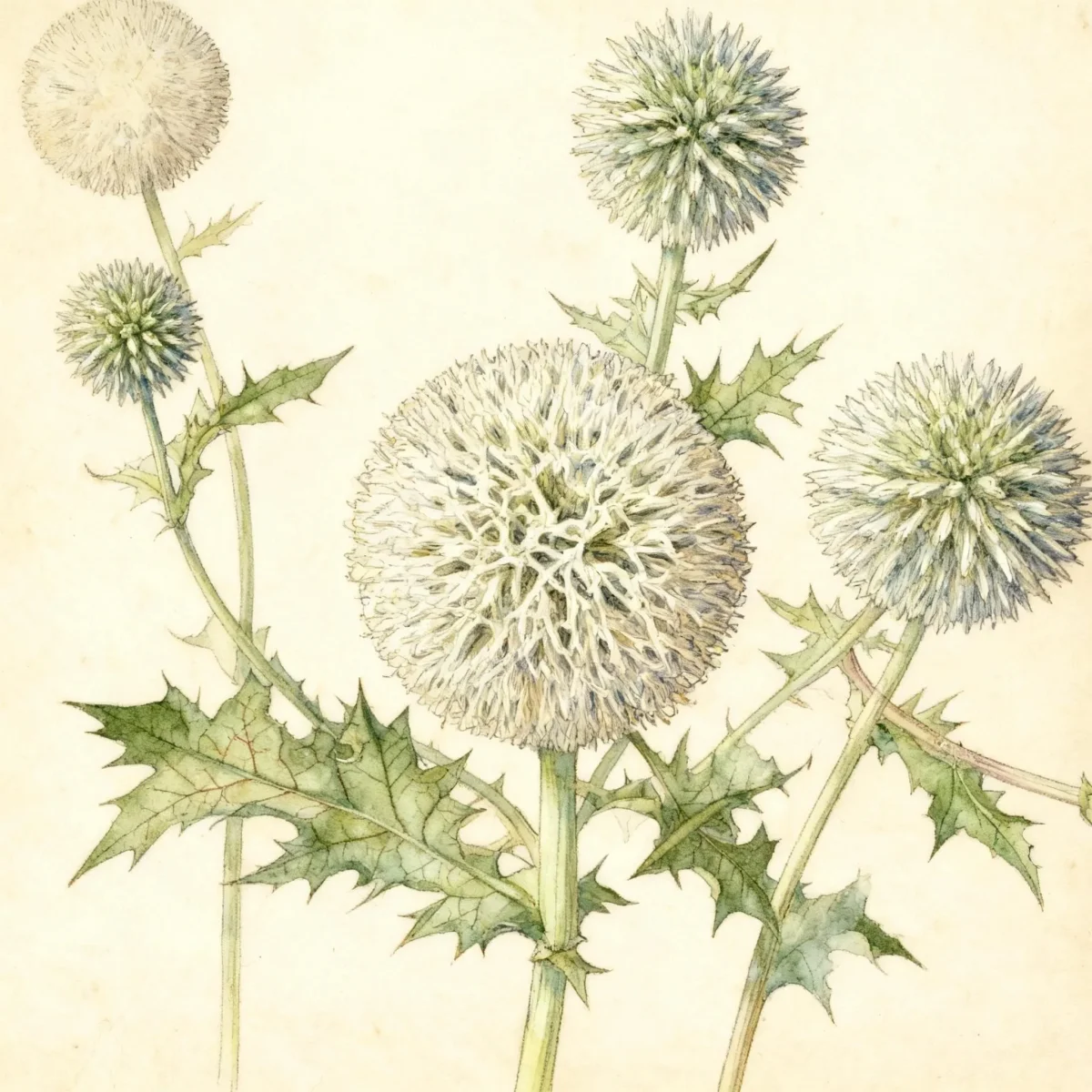
Great globe thistle (Echinops sphaerocephalus)
The bold, architectural Echinops sphaerocephalus (Great globe thistle) offers showy, spherical white blooms perfect for cut and dried arrangements.
Scroll down to discover growing tips, care requirements, companion plants, and more
Complete Plant Information
Overview
The Great globe thistle, Echinops sphaerocephalus, is a distinctly architectural plant, renowned for its striking, spherical flower heads that appear in mid-summer. As a bold, woolly-stemmed perennial in the sunflower family, it brings unique texture and structure to perennial borders, contrasting beautifully with softer, mounding plants. Its tolerance for poor, well-drained soils makes it a reliable choice for challenging garden spots.
Native to meadows and rocky areas across Southern and Central Europe, Echinops sphaerocephalus has earned its place in gardens globally for its low maintenance requirements and excellent performance in full sun. The distinctive blooms, which open white to lilac-white, are magnets for pollinators while they are fresh.
Beyond its summer display, this plant offers significant functional value. The dried seed heads retain their shape, providing winter interest long after the color fades. Gardeners appreciate the Great globe thistle for its hardiness and its ability to thrive with minimal intervention once established.
Fast Facts
- Plant Family: Asteraceae
- Plant Type: Herbaceous perennial
- Native Range: Southern and central Europe to Russia
- Hardiness Zones: USDA Zones 3-9
- Size at Maturity:
- Height: 2-3 ft
- Spread: 2-3 ft
- Bloom Time: June to August
- Bloom Description: White
- Sun Exposure: Full sun
- Water Needs: Dry to medium
- Maintenance Level: Low
How to Grow
Plant Echinops sphaerocephalus in spring after the last frost, or in early fall, ensuring it receives full sun exposure. This plant adapts well to average soils, but it truly excels where the soil is well-drained. While it prefers consistently moist conditions when young, established globethistles tolerate surprisingly dry periods, living up to its drought tolerance designation.
Maintenance for the Great globe thistle is generally minimal. Avoid high-fertility soils, as this can lead to overly lush, floppy growth, potentially necessitating staking for taller stems. Water primarily when the soil is dry to the touch, especially during initial establishment periods. No routine fertilizing is typically required.
To encourage a longer bloom period, deadheading the fading flower heads of Echinops sphaerocephalus is beneficial. However, many gardeners choose to leave the globe heads standing for winter interest, allowing the seed structures to provide architectural form in the dormant season. Be aware that established plants develop deep taproots, making them very difficult to move or divide successfully.
If you choose to clean up the garden in late fall, you can trim the spent stems to the ground. Alternatively, leaving the structures up provides texture and structure throughout winter months. Starting Echinops sphaerocephalus from scratch is easy via seed, and these new plants will not have the deep root system of older specimens, making them easier to manage initially.
Landscape Uses
The bold structure of the Great globe thistle makes it an excellent accent plant in sunny borders where its architectural form can stand out. It fits perfectly into cottage gardens, offering a fuzzy, architectural contrast to soft flowering companions like salvias or nepeta. Because it naturalizes well, it should be placed where its eventual spread is welcome, or where its strong presence can anchor a larger planting scheme.
Consider using Echinops sphaerocephalus in small groups to create focal points, particularly near structures or pathways where its unique form can be easily appreciated up close. Its sharp, thistle-like foliage adds texture that deters casual browsing by deer or rabbits. For a dynamic late-summer scene, pair its white globes with deep purple coneflowers or tall ornamental grasses for complementary forms and colors.
Standout Features
Flower Qualities
- Showy
- Good Cut
- Good Dried
Noteworthy Characteristics
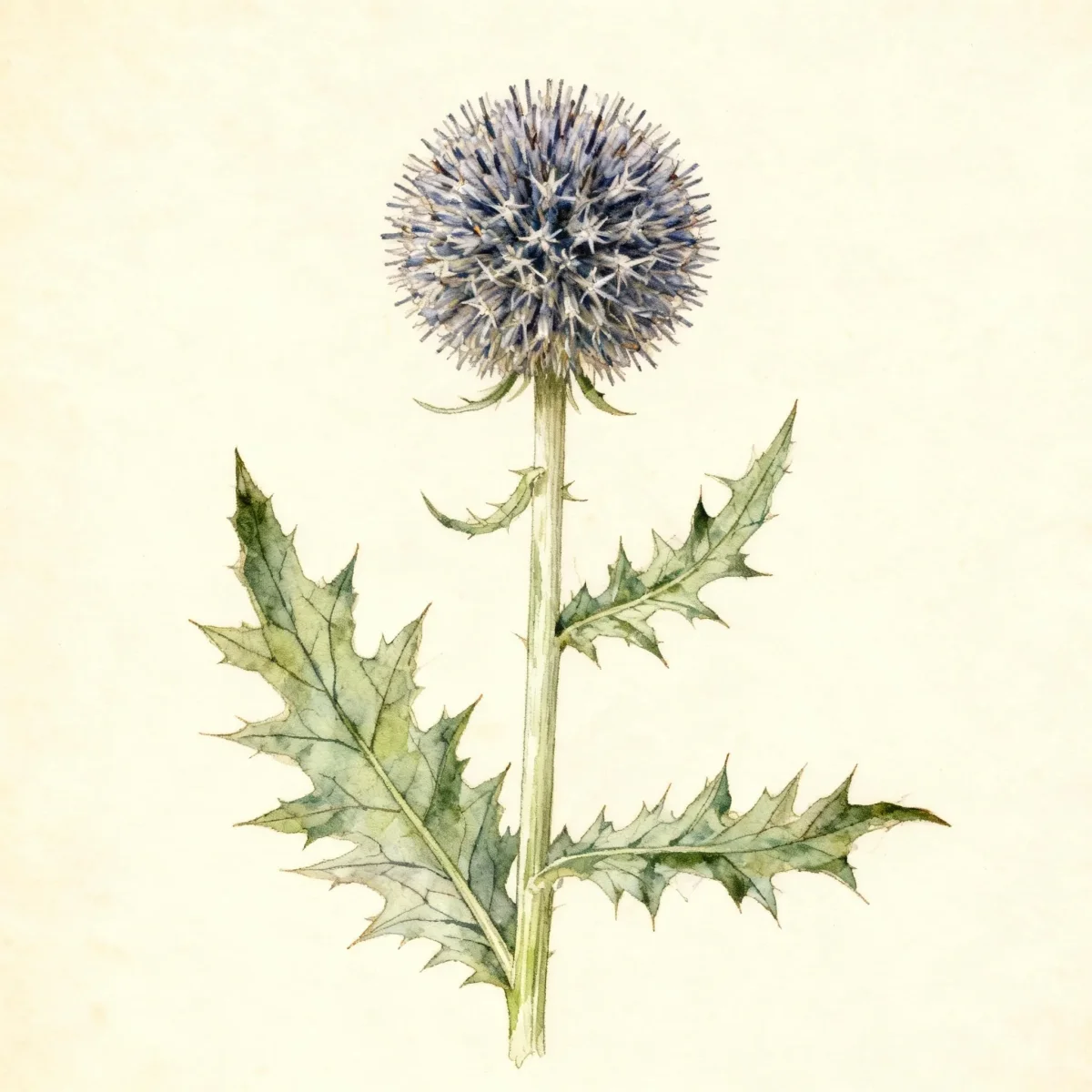
Echinops sphaerocephalus, commonly known as great globe-thistle, is a bold, woolly-stemmed perennial in the thistle tribe of the composite (sunflower) family. It is native to meadows, fields, rocky brushy places and disturbed habitats in Europe and western Asia, but has been introduced in other places around the world including North America where it has naturalized over time in a number of locations in Canada from Quebec to Saskatchewan and in the U.S. From Maine to Minnesota south to Illinois, Kentucky and Virginia plus Wyoming, Colorado, Washington, Oregon and California. Upright-branching gray stems typically rise to 3’ tall and to 2-3’ wide, but infrequently in the wild soar to as much as 4-7’ tall. Stems are clad with coarse, glandular, sinuate-pinnatifid, deeply dissected, thistle-like, green to gray-green leaves (to 14” long) which have spiny-toothed margins and white tomentose undersides. Each stem is topped in summer (late June- August) with a showy, thistle-like, spherical inflorescence (to 2” diameter) filled with lilac-white disk florets (rays absent). Fruits are hairy cylindrical achenes (1/3”) which ripen from September to October.
Tolerances
- Drought
- Dry Soil
Potential Problems
This species is generally robust, presenting no serious insect or disease problems in standard garden settings. The main physical consideration involves its stature; taller stems of Echinops sphaerocephalus may require staking, especially if the plant is situated in rich, fertile soils that encourage excessive, weaker top growth. Prevent this by avoiding heavy fertilization.
If staking becomes necessary, it is best done early in the season before the rigid stems fully develop. If you desire a shorter plant or wish to avoid staking altogether, a mid-spring shearing can promote a bushier, more compact habit, though this may also slightly delay the peak bloom time.
Frequently Asked Questions
What hardiness zones is Great globe thistle suitable for?
The Great globe thistle (Echinops sphaerocephalus) is highly adaptable, suitable for USDA Zones 3 through 9.
How large does Great globe thistle grow?
This perennial typically reaches a mature height between 2 and 3 feet tall with a corresponding spread of 2 to 3 feet wide.
When does Great globe thistle bloom?
Echinops sphaerocephalus provides its showy display of white blooms primarily from June through August.
What sun exposure does Great globe thistle need?
For optimal flowering and sturdy growth, Echinops sphaerocephalus requires consistently full sun exposure in the garden.
Conclusion
The Echinops sphaerocephalus, or Great globe thistle, is an indispensable addition for gardeners seeking bold texture and low-maintenance reliability. Its architectural form and excellent value as a cut or dried flower make it a perennial winner. Before planting, confirm your site offers full sun and excellent drainage to ensure the best display from your Echinops sphaerocephalus.
Companion Planting
When selecting companions for Echinops sphaerocephalus, focus on plants that share its love for full sun and excellent drainage. Airy, purple-blue flowers contrast beautifully with the stiff white globes of the thistle. Consider pairing it with Perovskia atriplicifolia (Russian Sage), whose silvery stems echo the thistle’s fuzzy foliage, or Nepeta (Catmint) planted lower toward the front of the border to soften the base.
For height and color contrast, plants like Vernonia (Ironweed) or Liatris spicata (Blazing Star) work well, as they share similar architectural habits and bloom times. Since the Great globe thistle can become quite established and dislikes disturbance, place fast-growing annuals nearby initially, knowing the thistle will eventually dominate the middle or back of the border.
Wildlife Benefits
The globe-shaped flower heads of Echinops sphaerocephalus are highly attractive to a wide variety of pollinators, making it a fantastic choice for ecologically focused gardens. Bees, especially honeybees and bumblebees, flock to the massed florets during the mid-summer blooming period.
Furthermore, allowing the seed heads to mature provides crucial late-season food sources. The hairy cylindrical achenes that ripen in fall and winter are utilized by various seed-eating songbirds. By leaving the spent stems standing through winter, you contribute structure to the dormant landscape while supporting local wildlife.