Spanish moss (Tillandsia usneoides)
Discover Tillandsia usneoides, Spanish moss, a low-maintenance epiphyte thriving in humid zones 8-11 with fascinating gray, stringy foliage.
Scroll down to discover growing tips, care requirements, companion plants, and more
Complete Plant Information
Overview
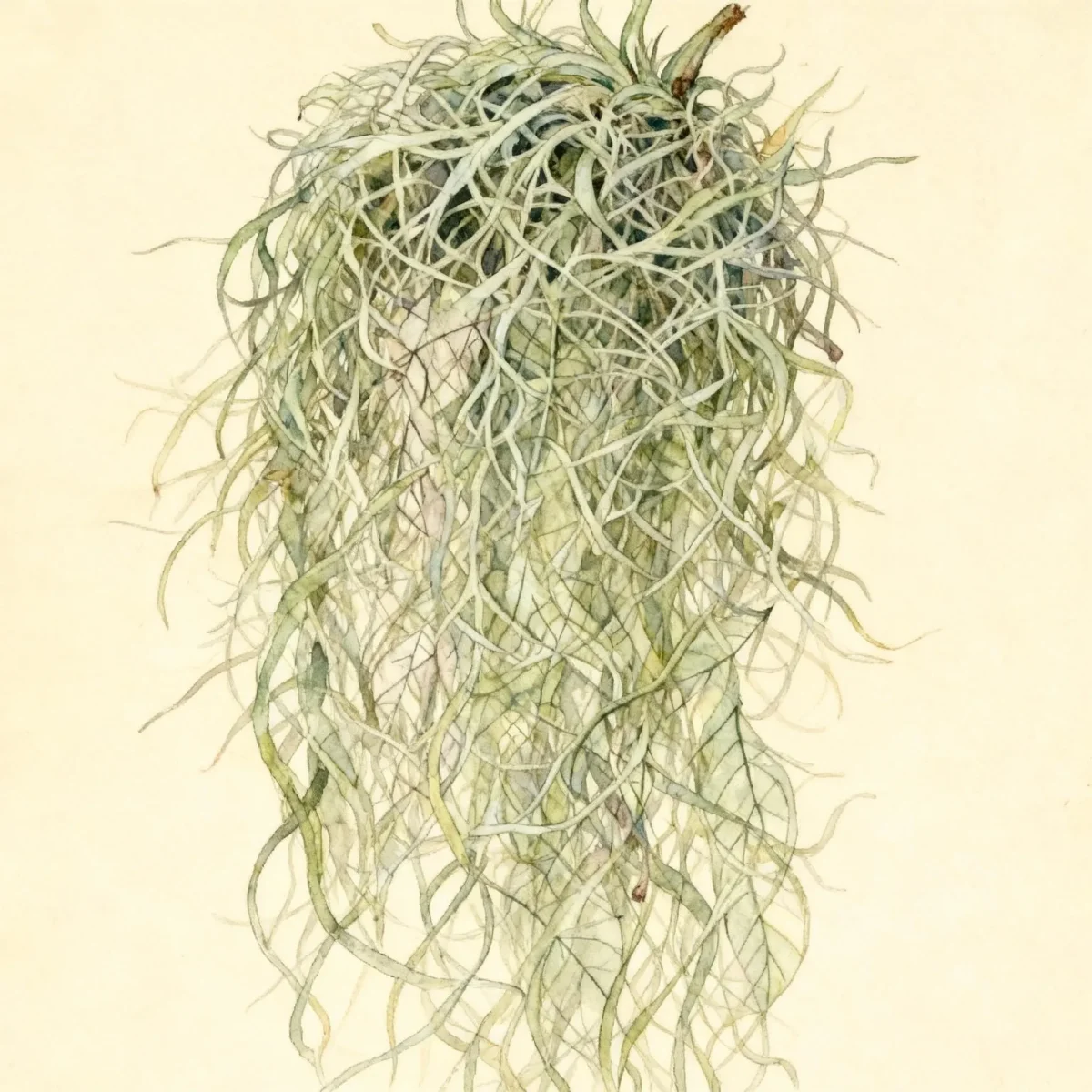
Tillandsia usneoides, commonly known as Spanish moss, is one of the most iconic and visually striking epiphytes found throughout the deep South of the United States and throughout the tropical Americas. This unique bromeliad is instantly recognizable by its long, draping strands of fuzzy, grayish-green foliage that creates a dramatic, ethereal effect on the branches it inhabits. Unlike parasitic plants, Spanish moss attaches to host trees merely for structural support, absorbing all necessary water and nutrients directly from the air and rain.
Growing Tillandsia usneoides is simple, making it a favorite for low-effort landscape accents where high humidity prevails. It exhibits a low maintenance profile, requiring little more than adequate moisture and suitable temperatures within USDA Zones 8 through 11. Although it can reach impressive lengths up to 20 feet, its spread is relatively narrow, draping rather than vigorously expanding outward.
The plant’s aesthetic appeal extends beyond its ghostly appearance; historically, it served practical uses as stuffing and insulation. Today, gardeners appreciate Spanish moss primarily for its dramatic ornamental value, its use in naturalizing landscapes, and its role in arts and crafts, perfectly complementing classic Southern flora like live oaks and cypress trees.
Fast Facts
- Plant Family: Bromeliaceae
- Plant Type: Epiphyte
- Native Range: Tropical Americas
- Hardiness Zones: USDA Zones 8-11
- Size at Maturity:
- Height: 3-20 ft
- Spread: 1-3 ft
- Bloom Time: Rarely flowers
- Bloom Description: Pale blue or green
- Sun Exposure: Full sun to part shade
- Water Needs: Medium
- Maintenance Level: Low
How to Grow
Cultivating this epiphyte successfully centers on replicating its humid, warm natural habitat. Tillandsia usneoides should be placed where it receives partial to full sun, though prolonged, intense midday heat can scorch the strands; best performance is often observed in shadier areas draped under mature tree canopies. It is crucial to note that this plant requires unpolluted, warm, and humid ambient air to thrive, performing exceptionally well in swampy or coastal environments.
Watering Spanish moss is straightforward as it is naturally adapted to atmospheric moisture capture. The stem surfaces are covered in specialized scales that wick up water and nutrients directly from the air or rain. During hot or dry periods, ensure the plant receives supplemental moisture, perhaps by spraying the strands as needed using a hose or sprinkler, particularly if high humidity levels drop significantly.
Maintenance for Tillandsia usneoides is minimal, classified as low maintenance. No root pruning or soil amendment is necessary since it is rootless and obtains its sustenance from the atmosphere. Strands spread naturally as small fragments break off and are carried by wind or birds to new host branches. Propagation can also occur via the tiny seeds released from small capsules when the rare flowers mature.
Because Spanish moss is frost tender, gardeners in the cooler reaches of its hardiness range (Zone 8) must provide protection or grow the plant indoors or in a protected greenhouse during impending frosts. Ensure that whatever structure it hangs from allows for good air circulation around the dangling strands to prevent rot.
Landscape Uses
The primary role of Tillandsia usneoides in the landscape is ornamental, lending an immediate sense of age and atmosphere to any setting. It is ideally suited for naturalizing beneath large, established trees such as Southern Magnolias, Live Oaks, and Bald Cypress, mimicking its indigenous growth pattern along swamps and riverbanks. Avoid planting this highly aesthetic plant near buildings where falling strands might cause cleaning issues, or near highly toxic plants if you have pets or children frequently exploring those areas.
For a curated garden look, Spanish moss can be draped artfully over deadwood structures, arbors, or even placed strategically in containers alongside moisture-loving tropicals acting as a dramatic, trailing filler material. Its ability to create curtains of flowing gray contrasts spectacularly with the deep green foliage of most traditional Southern shrubs and groundcovers.
Beyond its visual impact, the fibrous material harvested from older Tillandsia usneoides—historically used for stuffing—can still be utilized today as a unique, airy mulch around acid-loving container plants or incorporated into terrariums for texture, provided you source sustainable or ethically wild-harvested material.
Standout Features
Flower Qualities
- Insignificant
Noteworthy Characteristics
Tillandsia usneoides, commonly called Spanish moss, is an epiphytic, fibrous and rootless perennial (bromelliad family) that typically wraps around and droops from branches or slabs of bark of host trees. It is noted for having stringy gray stems (1/32” in diameter) and narrow linear fuzzy gray leaves (to 2-3” long). The name Spanish moss is somewhat contested; French settlers referred to it as Barbe Espagnol (Spanish beard), likely referencing the long facial hair common on Spanish explorers. This plant is native throughout the Americas and thrives in wet habitats like swamps and rainforests.
Tolerances
- Frost tender
Potential Problems
This resilient epiphyte generally experiences no serious insect or disease problems under optimal growing conditions. Because Spanish moss absorbs nutrients and moisture directly from the air and rain, root-borne pests or soil diseases are not a concern. The primary concern is environmental: insufficient humidity or prolonged freezing temperatures will quickly damage or kill the strands. Ensure good air movement around the hanging masses to prevent fungal issues associated with stagnation, although this is rarely an issue outdoors in its native range.
Frequently Asked Questions
What hardiness zones is Spanish moss suitable for?
Tillandsia usneoides is reliably winter hardy in USDA Zones 8 through 11, provided the air remains warm and humid.
How large does Tillandsia usneoides grow?
The strands of Spanish moss can drape downward significantly, often reaching heights of 3 feet up to 20 feet long, though the plant itself has a minimal spread of 1 to 3 feet wide.
What sun exposure does Spanish moss need?
This plant prefers full sun to part shade, thriving particularly well when protected slightly from the harshest midday sun in very hot climates.
Conclusion
Tillandsia usneoides, or Spanish moss, offers unparalleled vertical drama and an immediate connection to Southern ecology with remarkably low input from the gardener. Its unique physiology as an air-feeding epiphyte makes it a fascinating subject. Before introducing Spanish moss to your trees, confirm that your location falls within Zones 8-11 and that you can provide the necessary warm, humid air it requires for sustained growth.
Companion Planting
When incorporating Tillandsia usneoides into a landscape, select host trees that naturally welcome the draping effect without suffering from too much shade blockage. Bald Cypress (Taxodium distichum) and Live Oak (Quercus virginiana) are classic companions, as they can handle moist to wet conditions typical of areas where Spanish moss flourishes. For container gardens or ground layers beneath trees hosting the moss, select plants that also appreciate bright, indirect light and consistent moisture, such as ferns (like various Osmunda species) or moisture-loving Astilbes if the light permits.
Propagation Tips
Apart from the rare natural dispersal of wind-borne seeds, propagating Spanish moss is easily achieved through fragmentation. Simply take strands of mature Tillandsia usneoides—at least 6 to 12 inches long are ideal—and gently tie or drape them onto the branches of an appropriate host tree or sturdy structure. Ensure the new placement allows for good air flow, as moisture absorption is key to establishing the new segment. No rooting hormone is required; the scales on the stems will immediately begin absorbing ambient moisture, establishing the new colony. Large commercial operations once relied on this technique for harvesting material used in upholstery.