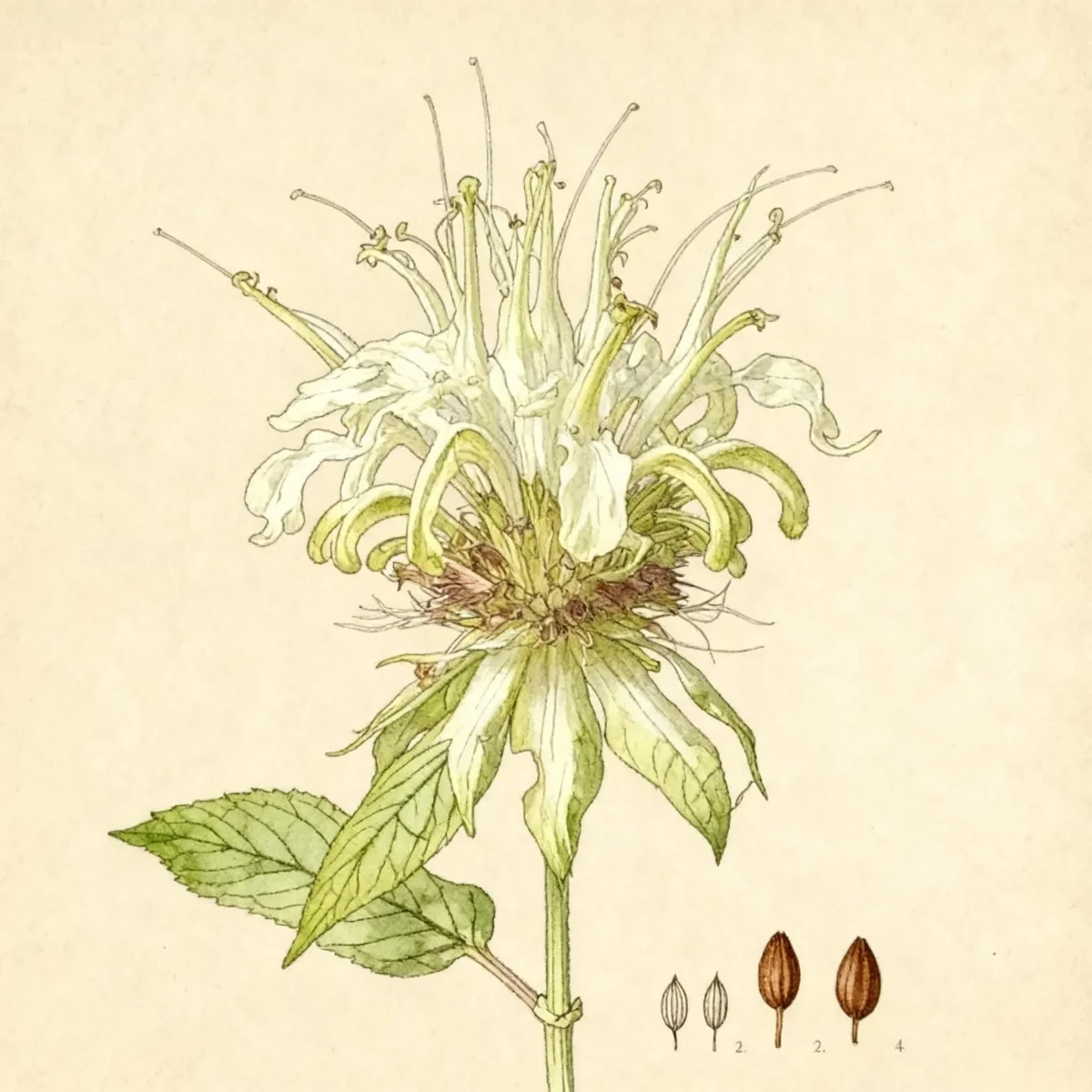
White bergamot (Monarda clinopodia)
Monarda clinopodia (White bergamot) is a low-maintenance perennial prized for its white-dotted spring-to-fall blooms.
Scroll down to discover growing tips, care requirements, companion plants, and more
Complete Plant Information
Overview
Monarda clinopodia, commonly known as White bergamot, is a valuable herbaceous perennial native to rich woodlands across the Eastern United States. It offers an extended bloom time, providing attractive interest from late spring deep into early fall. Gardeners appreciate this species for its relatively low maintenance needs and its ability to thrive in diverse soil conditions.
This mint-family member features striking terminal clusters of small white flowers speckled with purple dots, which are known attractants for hummingbirds and butterflies. Reaching heights between 2 and 4 feet, the White bergamot forms substantial clumps that are excellent for naturalizing within larger garden settings.
The foliage of Monarda clinopodia releases a pleasant, minty fragrance when crushed, an olfactory bonus that adds another dimension to the garden landscape. Its robust nature makes it a reliable choice for regions within USDA Zones 5 through 8 seeking native, pollinator-friendly texture.
Fast Facts
- Plant Family: Lamiaceae
- Plant Type: Herbaceous perennial
- Native Range: Eastern United States
- Hardiness Zones: USDA Zones 5-8
- Size at Maturity:
- Height: 2-4 ft
- Spread: 2-4 ft
- Bloom Time: May to September
- Bloom Description: White with purple spots
- Sun Exposure: Full sun to part shade
- Water Needs: Medium
- Maintenance Level: Low
How to Grow
Establish Monarda clinopodia best during the spring or fall when the weather is mild, allowing it to establish robust root systems before summer heat. This species performs well in evenly moist, humusy, well-draining soil, though it exhibits notable tolerance for tougher sites. Sunlight requirements are flexible; aim for full sun for best flowering, but White bergamot adapts well to partial shade or dappled woodland light.
Care for established plants is minimal, fitting its “Low” maintenance quotient. Provide consistent medium water, especially during prolonged dry spells in its first year. Fertilization is generally unnecessary if the soil contains adequate organic matter. A key cultural consideration for this plant is its growth habit: mature clumps can sometimes become floppy.
To manage the potential floppiness, either stake the stems early in the season or plant the Monarda clinopodia closely alongside more upright, sturdy companion species. There is no significant pruning required outside of removing spent flower stalks if self-seeding is not desired. Deer typically ignore this fragrant perennial, offering built-in protection.
Landscape Uses
The primary suggested use for Monarda clinopodia is to allow it to naturalize, creating informal drifts within the landscape. This spreading tendency makes it perfect for softening the edges of woodland plantings or filling in areas beneath taller deciduous trees where dappled light persists. Its height allows it to function effectively in the middle ground of a border setting.
Consider using White bergamot to establish dedicated habitat gardens. It is an excellent component in butterfly gardens and hummingbird gardens, drawing beneficial wildlife consistently throughout the summer months due to its extended bloom period. When massed, the white blooms provide a lovely contrast against dark green foliage or deep-colored flowering partners.
Standout Features
Noteworthy Characteristics
Monarda clinopodia, commonly called white bergamont and basil beebalm, is a herbaceous perennial native to the eastern United States from the Mid-Atlantic south to central Alabama and west to Illinois. It can be found in rich, moist woodlands, wooded ravines, pastures, fields, along streambanks and roadsides. The oppositely arranged, 5-6” long, toothed leaves release a minty fragrance when rubbed or crushed, and the sturdy stems often feature attractive maroon-red coloration. Terminal clusters of 1” long, white flowers with purple dotted lower lips bloom from late spring until early fall, making this plant highly attractive to hummingbirds and butterflies.
Tolerances
- Clay Soil
- Dry Soil
Potential Problems
Monarda clinopodia is noted for possessing good natural resistance to powdery mildew, a common ailment among the Monarda genus. The main cultural challenge gardeners face is that the growth habit tends to be floppy, especially when growth is lush or sun exposure is reduced. To manage floppiness, consider staking the stems when they are young or planting companion species nearby that can provide physical support. Deer browsing is generally not a concern as they tend to avoid the aromatic foliage.
Frequently Asked Questions
What hardiness zones is White bergamot suitable for?
White bergamot, Monarda clinopodia, is reliably hardy across USDA Zones 5 through 8. Be sure your garden location falls within this range for best perennial performance.
How large does Monarda clinopodia grow?
Mature clumps typically reach a height spread of 2 to 4 feet tall, with a similar spread, making it a substantial mid-border or naturalizing plant.
When does White bergamot bloom?
This perennial puts on a long show, blooming from May all the way through September, generally peaking during the summer months. The flowers are distinctly white with purple spots.
What sun exposure does White bergamot need?
Monarda clinopodia prefers full sun for optimal flowering but is quite adaptable and performs well in partial shade conditions as well.
Conclusion
Monarda clinopodia offers reliability, extended bloom time, and strong support for local wildlife, making it a fantastic asset for native and low-maintenance gardens. If you appreciate the unique structure and fragrance of the beebalm family, White bergamot is an excellent, relatively robust selection. Before planting, confirm your local hardiness zone and ensure you have a spot that offers at least partial sun exposure.
Companion Planting Strategies
Selecting companions carefully can address the only major cultural need of Monarda clinopodia: support. Look for plants with strong, upright habits that share similar cultural needs for medium moisture and partial sun. Hostas, ferns, and taller native grasses work well structurally beneath or alongside the beebalm. Aesthetically, pair the white blooms of White bergamot with purple or blue-flowering species like Amsonia (Blue Star) or Baptisia for traditional cottage garden color contrast.
Wildlife Benefits
The greatest functional benefit of growing Monarda clinopodia is its appeal to pollinators. The unique tubular shape of the white flowers is perfectly adapted for long-tongued visitors. Hummingbirds are strongly attracted to the blooms, seeking the nectar reward, while butterflies readily utilize the flowers as a summer refueling station. Planting a patch of White bergamot contributes significantly to supporting local insect biodiversity throughout the season.